



Running a small business in Grantham or across Lincolnshire means standing out in a crowded market can feel tough, especially when your website looks like everyone else’s. Clear digital communication is more vital than ever as custom websites provide the freedom to truly reflect your unique brand and connect with customers. This guide breaks down what sets a bespoke website apart, challenges common myths, and shows how the right approach can put your business ahead.
Key Takeaways
| Point | Details |
|---|---|
| Custom Websites Offer Unique Benefits | Custom websites provide tailored digital solutions that enhance performance, security, and brand alignment for businesses. |
| Common Myths About Custom Websites | Many small businesses mistakenly believe that custom websites are prohibitively expensive or only suitable for large corporations, hindering their investment in digital transformation. |
| Strategic Website Types for Small Businesses | Different types of websites, such as e-commerce and service booking platforms, serve specific objectives that can significantly impact business growth and customer engagement. |
| Choosing the Right Development Partner is Crucial | Selecting a knowledgeable web development partner can greatly enhance a business’s digital strategy, ensuring long-term success through tailored solutions and ongoing support. |
Defining Custom Websites and Common Myths
Custom websites represent far more than basic online platforms - they are strategic digital assets designed to reflect a business’s unique identity and operational needs. Unlike standard template-based solutions, these bespoke digital experiences are crafted to address specific organisational requirements and deliver targeted functionality.
The digital landscape has fundamentally transformed how businesses communicate online, with digital interaction paradigms shifting dramatically. Many organisations still operate under outdated Web 1.0 models, limiting their potential for meaningful customer engagement. A truly custom website moves beyond mere digital presence to become an interactive, dynamic representation of a brand.
Key characteristics of custom websites include:
- Complete design flexibility tailored to brand aesthetics
- Unique functionality matching specific business processes
- Enhanced performance and loading speeds
- Superior security configurations
- Direct integration with existing business systems
Common myths about custom websites often discourage small and medium enterprises from investing in bespoke digital solutions. These misconceptions typically revolve around perceived complexity, high costs, and technical challenges. However, modern web development approaches have made custom websites increasingly accessible and cost-effective for businesses of all sizes.
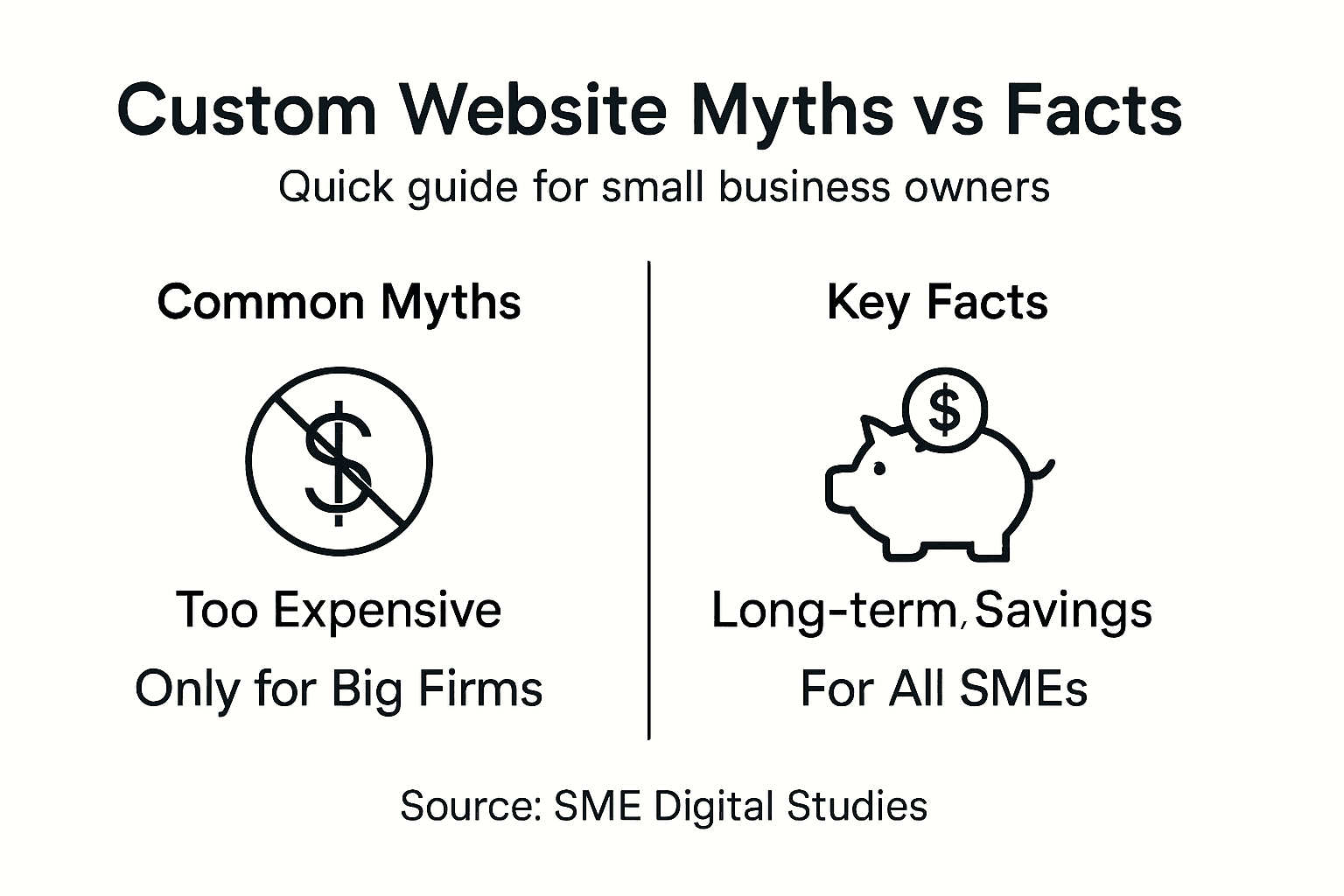
Myth 1: Custom Websites Are Too Expensive
Contrary to popular belief, custom websites can offer long-term cost savings by eliminating recurring template licensing fees and reducing maintenance complexity. They provide a more efficient digital solution tailored precisely to business needs.
Myth 2: Only Large Corporations Need Custom Sites
Small businesses benefit significantly from custom websites that reflect their unique brand personality and serve specific customer segments. A tailored digital presence can differentiate a local enterprise in competitive markets.
Myth 3: Template Websites Are Just as Good
While templates offer quick deployment, they lack the nuanced functionality and brand alignment that custom websites provide. A bespoke site enables businesses to create truly distinctive online experiences.
Pro tip: Conduct a thorough audit of your current website to identify specific customisation requirements that could enhance your digital performance.
Types of Custom Websites for Small Businesses
Small businesses today require sophisticated digital platforms that go beyond simple online brochures. Multiple website types serve distinct business objectives, enabling organisations to create targeted digital experiences that drive growth and engage customers effectively.
The digital ecosystem offers several strategic website configurations tailored for small enterprise needs. Each type addresses specific business requirements, allowing entrepreneurs to craft a digital presence that precisely matches their operational goals and market positioning.
Key website types for small businesses include:
-
Business Information Websites
- Provide comprehensive company details
- Showcase products and services
- Build brand credibility
-
E-commerce Platforms
- Enable direct online sales
- Integrate payment gateways
- Manage product inventories
-
Portfolio Websites
- Display professional work samples
- Highlight client achievements
- Demonstrate expertise visually
-
Service Booking Websites
- Allow online appointment scheduling
- Integrate client management systems
- Reduce administrative overhead
Each website type offers unique advantages for small businesses seeking to establish a robust digital footprint. E-commerce platforms, for instance, allow local enterprises to extend their market reach beyond physical boundaries, while portfolio sites provide professional service providers a sophisticated method of showcasing their capabilities.
Here is a comparison of website types highlighting their strategic value for small businesses:
| Website Type | Business Objective | Best For |
|---|---|---|
| Informational | Build trust | Establishing credibility |
| E-commerce | Enable direct sales | Growing online revenue |
| Portfolio | Showcase work | Attracting new clients |
| Service Booking | Simplify scheduling | Streamlining appointments |
The selection of an appropriate website type depends on multiple factors including business model, target audience, and specific industry requirements. Some organisations might benefit from hybrid approaches that combine multiple website functionalities to create a comprehensive digital strategy.
Pro tip: Consult with a web development professional to assess which website type best aligns with your specific business goals and target market needs.
Key Features Unique to Custom Sites
Custom websites represent a transformative approach for small businesses seeking digital excellence. Custom web development provides scalable solutions that transcend the limitations of generic template-based platforms, offering businesses unprecedented control over their online presence.
Unlike standardised website templates, custom sites deliver a range of sophisticated features specifically engineered to meet unique business requirements. These tailored digital platforms enable organisations to create more engaging, efficient, and strategic online experiences that directly align with their operational objectives.
Key unique features of custom websites include:
-
Advanced Performance Optimisation
- Faster loading speeds
- Streamlined code architecture
- Minimal unnecessary software bloat
-
Seamless Third-Party Integrations
- Direct connection with business systems
- Custom API development
- Tailored workflow automation
-
Enhanced Security Configurations
- Bespoke security protocols
- Reduced vulnerability to standard web attacks
- Continuous security monitoring
-
Flexible Design Scalability
- Adaptable to business growth
- Easy future modifications
- Consistent brand representation
Businesses gain significant competitive advantages through these specialised digital solutions. Custom websites allow for precise functionality that reflects an organisation’s unique operational needs, enabling more effective customer interactions and streamlined internal processes.
The strategic value of custom websites extends beyond mere aesthetics. By providing tailored user experiences and integrated business logic, these platforms transform digital presence from a basic online brochure to a powerful operational tool that drives growth and efficiency.
The following table outlines key strategic advantages of custom website features:
| Custom Feature | Business Impact | Long-Term Benefit |
|---|---|---|
| Bespoke Security | Protect sensitive data | Reduced cyber risks |
| Seamless System Integration | Automate workflows | Improved operational efficiency |
| Advanced Performance | Enhanced user experience | Higher customer retention |
| Scalable Design | Supports future growth | Easier site updates |
Pro tip: Prioritise understanding your specific business requirements before commissioning a custom website to ensure maximum alignment with your strategic objectives.
Measuring Impact: SEO, Branding, and ROI
Custom websites represent strategic investments that extend far beyond mere digital presence, offering measurable outcomes for small businesses. Digital marketing strategies drive economic transformation through sophisticated online performance metrics that directly correlate with business growth and market expansion.

Comprehensive impact measurement involves analysing multiple interconnected dimensions that demonstrate a custom website’s effectiveness. These dimensions include search engine visibility, brand perception, customer engagement, and direct financial returns - each providing critical insights into the digital platform’s strategic value.
Key performance indicators for measuring website impact include:
-
Search Engine Optimisation (SEO) Metrics
- Organic search rankings
- Website traffic volume
- Keyword performance
- Click-through rates
-
Branding Performance Indicators
- Brand visibility
- Online reputation
- User engagement duration
- Social media referrals
-
Financial Return Measurements
- Conversion rates
- Cost per acquisition
- Revenue generated from online channels
- Customer lifetime value
Businesses can leverage advanced analytical tools to track these metrics comprehensively. By understanding the nuanced relationships between website performance and business outcomes, organisations can make data-driven decisions that continuously refine their digital strategies.
The true value of a custom website emerges through its ability to provide granular insights and adaptable performance tracking. Unlike standard template solutions, bespoke platforms enable precise measurement of every digital interaction, transforming websites from passive marketing tools into active business intelligence platforms.
Pro tip: Implement comprehensive web analytics and set specific, measurable goals to track your custom website’s performance across multiple strategic dimensions.
Comparing Custom vs Template Solutions
Small businesses face a critical decision when establishing their digital presence: choosing between template-based websites and bespoke custom solutions. Website design strategies directly impact business performance through technological flexibility, brand representation, and operational efficiency.
Template websites offer quick deployment and lower initial costs, but they come with significant limitations that can hinder a business’s digital growth strategy. Custom websites, by contrast, provide tailored solutions that adapt precisely to unique organisational requirements, offering a more strategic approach to online presence.
Key differences between custom and template solutions include:
-
Design Flexibility
- Template: Rigid, predetermined layouts
- Custom: Unlimited design possibilities
- Fully aligned with brand identity
-
Functionality
- Template: Generic, one-size-fits-all features
- Custom: Specific business process integrations
- Scalable to evolving business needs
-
Performance
- Template: Standard loading speeds
- Custom: Optimised performance
- Faster user experience
-
Security
- Template: Generic protection layers
- Custom: Tailored security configurations
- Reduced vulnerability to standard attacks
Many businesses mistakenly view templates as cost-effective solutions without considering long-term implications. While initial investment might seem lower, template websites often require ongoing compromises in functionality, brand representation, and user experience.
Custom websites represent a strategic investment that transcends mere digital presence. They enable businesses to create unique digital experiences that reflect their specific brand personality, operational workflows, and customer interaction models.
Pro tip: Conduct a comprehensive audit of your business requirements before selecting between template and custom website solutions to ensure optimal digital strategy alignment.
Costs, Ongoing Support and Choosing a Partner
Navigating the landscape of custom website development requires strategic financial planning and careful partner selection. Web development partner selection impacts long-term digital success through comprehensive evaluation of technical capabilities, communication standards, and strategic alignment.
Cost considerations for custom website development extend far beyond initial build expenses. Small businesses must understand the nuanced financial ecosystem of digital investment, which includes initial development, ongoing maintenance, future scalability, and potential return on investment.
Key financial and partnership considerations include:
-
Initial Development Costs
- Comprehensive project scope assessment
- Transparent pricing models
- Detailed breakdown of feature implementations
-
Ongoing Support Packages
- Regular maintenance agreements
- Performance monitoring services
- Security update provisions
- Technical support channels
-
Partner Selection Criteria
- Proven industry experience
- Portfolio of similar project deliveries
- Technical expertise verification
- Communication and responsiveness
- Cultural compatibility
The total cost of a custom website involves multiple layers beyond surface-level pricing. Businesses should view this as a strategic investment rather than a simple transactional expense, understanding that the right digital partner can significantly amplify operational efficiency and market positioning.
Successful partnerships are built on clear communication, aligned expectations, and a shared vision of technological growth. Small businesses must seek web development partners who offer not just technical skills, but strategic insights that can transform digital infrastructure into a competitive advantage.
Pro tip: Request comprehensive proposals from multiple web development partners, comparing not just costs but also long-term value, support infrastructure, and strategic alignment with your business objectives.
Unlock Your Business Potential with Tailored Custom Websites
Understanding the unique challenges faced by SMEs today is vital to driving growth and enhancing your digital presence. As highlighted in the article, the common concerns around cost, scalability, and brand alignment can often hold businesses back from investing in custom websites that truly reflect their identity and operational needs. If you are looking to rise above generic template limitations and want solutions that deliver bespoke functionality, advanced security, and seamless integrations, your business deserves a website designed specifically for you.
At WebFuZsion, we specialise in creating custom websites, landing pages, and targeted SEO services crafted to propel small to medium-sized businesses across the UK forward. Our team understands how to transform your requirements into digital solutions with transparent pricing, ongoing support, and expert care tailored to your growth ambitions. Explore how our custom website services empower local and national businesses alike by simply starting with a conversation.
Don’t let outdated assumptions or off-the-shelf templates limit your potential. Take the first step today towards a fully customised online presence that drives measurable results. Visit WebFuZsion now to discover your bespoke web design options and let’s build a site that works as hard as you do.
Frequently Asked Questions
What are the benefits of having a custom website for my business?
Custom websites provide tailored solutions that reflect your unique brand identity, enhance functionality specific to your business processes, improve loading speeds, and offer superior security. They are designed to facilitate better customer engagement and drive growth for small and medium enterprises (SMEs).
How do custom websites compare to template-based sites?
Custom websites offer greater design flexibility, specific functionality tailored to business needs, optimised performance, and enhanced security compared to template-based solutions, which may have rigid layouts and generic features that can hinder a business’s digital growth.
Are custom websites cost-effective for small businesses?
Yes, while the initial investment may be higher than template-based sites, custom websites can result in long-term cost savings by eliminating recurring licensing fees and reducing the need for extensive maintenance, thus providing a more efficient digital solution tailored to business needs.
What key features should I consider when developing a custom website?
Focus on advanced performance optimisation, seamless third-party integrations, enhanced security configurations, and flexible design scalability. These features ensure that the website not only meets your current business requirements but can also adapt as your business grows.
Recommended
- Why Invest in Custom Websites for Business Growth | WebFuZsion Blog | WebFuZsion
- Do Businesses Still Need Websites? The… | WebFuZsion Blog | WebFuZsion
- The Importance of Having a Business… | WebFuZsion Blog | WebFuZsion
- How to Design a Website for Small Businesses… | WebFuZsion Blog | WebFuZsion
- 7 Shopify groeisuccessen voorbeelden en hun strategieën - Synwave Studio
- Marketing pour coach vocal : Clé d’une activité florissante