



Every business owner in Grantham and Lincolnshire recognises that a website should reflect your company’s professionalism and reliability. When your digital storefront becomes neglected or difficult to use, customers notice instantly, often turning away before you can engage them. Outdated websites carry hidden risks, from lost traffic to weakened trust, yet common myths hold many back from making necessary updates. This article clarifies what truly makes a website outdated and debunks the misconceptions that can hinder your business growth.
Key Takeaways
| Point | Details |
|---|---|
| Understanding Obsolescence | Website obsolescence includes technological, design, content, and functional types, each affecting user engagement and business competitiveness. |
| Importance of Regular Audits | Conduct website audits every 12-24 months to identify issues and ensure optimal performance and user experience. |
| Impact on SEO and Compliance | Redesigns must preserve SEO rankings and comply with laws; otherwise, businesses risk losing visibility and facing penalties. |
| Investment in Modernisation | A modernised website enhances user experience, improves search engine rankings, and increases conversion rates, offering substantial business advantages. |
Defining Outdated Websites and Common Myths
In the digital landscape of Lincolnshire’s small businesses, a website serves as more than just an online brochure - it’s the digital front door to your enterprise. An outdated website goes beyond mere visual design; it represents a technological ecosystem failing to meet modern user expectations, performance standards, and business objectives.
Many business owners harbour misconceptions about what constitutes an outdated website. These myths often prevent them from taking crucial steps towards digital transformation. Let’s deconstruct some common misunderstandings:
- Visual Appearance is Everything: An outdated website isn’t just about looking old-fashioned
- Cost Prevents Modernisation: Redesigns can be strategically budgeted and phased
- Our Current Site Still Works: Functionality isn’t the same as optimal performance
- We Don’t Need Mobile Responsiveness: Over 60% of web traffic now comes from mobile devices
A truly outdated website exhibits several critical characteristics that directly impact business growth. These include:
- Slow loading speeds
- Non-responsive design across devices
- Complicated navigation structures
- Lack of modern security protocols
- Poor search engine optimisation (SEO) capabilities
Technical obsolescence represents a significant risk for businesses. Modern web technologies have transformed how users interact with online platforms, creating expectations of seamless, intuitive experiences. Web performance metrics reveal that websites with outdated infrastructures lose potential customers within seconds of a poor initial interaction.
An outdated website is like a shop with dusty windows and broken signage - it communicates neglect before a customer even steps inside.
The consequences of maintaining an antiquated digital presence extend far beyond aesthetics. Search engines penalise websites with poor user experience, slow loading times, and non-responsive designs. This means reduced visibility, decreased traffic, and ultimately, diminished business opportunities.
Pro tip: Conduct a comprehensive website audit every 18-24 months to identify potential areas of technological and design improvement.
Types of Website Obsolescence and Their Impact
Website obsolescence is a multifaceted challenge that extends far beyond simple aesthetic concerns. Digital preservation research reveals that technological decay can dramatically undermine a business’s online effectiveness, creating significant barriers to customer engagement and digital competitiveness.
Understanding the various types of website obsolescence helps businesses proactively manage their digital infrastructure. The primary categories of obsolescence include:
- Technological Obsolescence: Outdated coding frameworks and technologies
- Design Obsolescence: Visual interfaces that no longer meet modern user expectations
- Content Obsolescence: Information that becomes irrelevant or inaccurate
- Functional Obsolescence: Features that fail to meet current user interaction standards
Each type of obsolescence carries distinct risks for small businesses. Digital preservation research demonstrates that technological advancements create continuous pressure for digital platforms to evolve, making regular assessment crucial.
To better understand the risks and strategies associated with website obsolescence, here is a summary table comparing the four main types:
| Obsolescence Type | Main Threat | Business Impact | Typical Solution |
|---|---|---|---|
| Technological | Outdated frameworks and tools | Loss of customers, poor performance | Technology upgrades |
| Design | Irrelevant visual interface | Weak brand perception | UX/UI redesign |
| Content | Inaccurate or stale information | Reduced trust, missed sales | Content review and updates |
| Functional | Unusable or missing features | Frustrated users, loss of revenue | Feature enhancement and testing |
The consequences of neglecting website modernisation can be profound. Search engines penalise websites with poor user experience, slow loading times, and non-responsive designs. This means reduced online visibility, decreased traffic, and ultimately, diminished business opportunities.
Technological obsolescence is not just about appearance - it’s about maintaining relevance in a rapidly changing digital ecosystem.
Businesses must recognise that website obsolescence is an ongoing process, not a one-time event. Regular audits, continuous learning, and strategic investments in digital infrastructure are essential for maintaining competitive advantage.
Pro tip: Schedule comprehensive website performance reviews every 12-18 months to identify and address potential areas of technological and design deterioration.
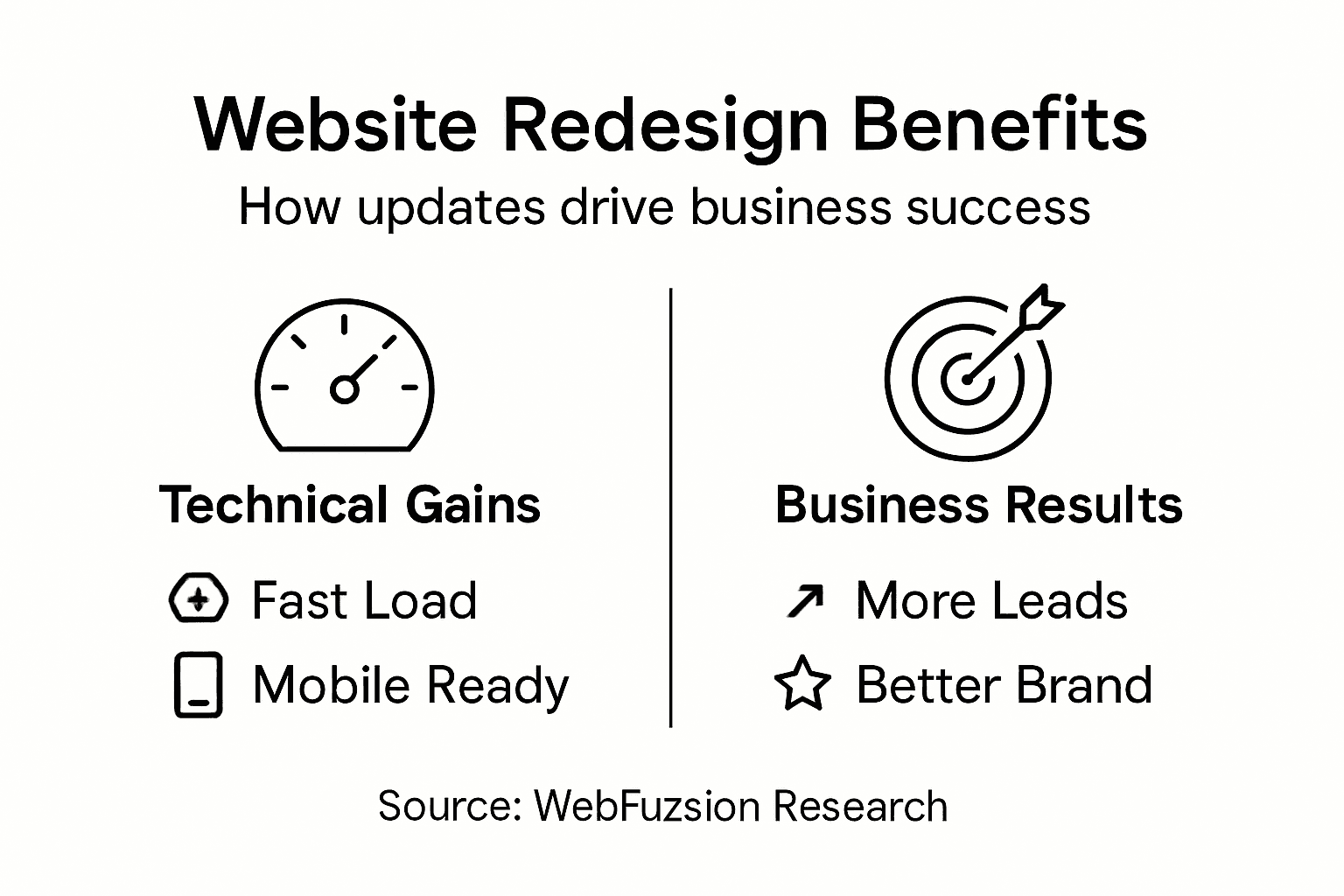
Key Benefits of a Modernised Website
A modernised website represents far more than a cosmetic upgrade - it’s a strategic business investment that directly impacts growth, visibility, and customer engagement. Website redesign research demonstrates how thoughtful digital transformation can revolutionise a company’s online presence and operational effectiveness.
The primary benefits of a modernised website encompass several critical business dimensions:
- Enhanced User Experience: Intuitive navigation and responsive design
- Improved Search Engine Rankings: Better technical performance and SEO optimisation
- Increased Conversion Rates: More compelling visual presentation and clearer calls-to-action
- Stronger Brand Credibility: Professional, contemporary digital representation
- Advanced Security Features: Protection against modern cybersecurity threats
Businesses that invest in website modernisation unlock significant competitive advantages. Digital performance research reveals that strategic redesigns can yield measurable improvements in customer engagement, with some organisations experiencing conversion rate increases of up to 30%.
A modern website is your digital storefront - it must communicate professionalism, reliability, and innovation at first glance.
Technical improvements extend beyond aesthetics. Modern websites offer faster loading speeds, seamless mobile responsiveness, and integration of advanced multimedia elements that capture and retain user attention. These technical enhancements directly correlate with improved user satisfaction and increased business opportunities.

Moreover, a well-designed website serves as a powerful marketing tool. It communicates your brand’s values, demonstrates your commitment to quality, and provides a platform for showcasing your products or services with unprecedented clarity and impact.
Pro tip: Conduct a comprehensive website performance audit annually, focusing on user experience metrics, loading speeds, and mobile responsiveness to identify potential improvement areas.
Financial, SEO, and Compliance Implications
Website redesign is not merely a cosmetic exercise but a strategic investment with profound financial, search engine, and regulatory implications. Website redesign research demonstrates how thoughtful digital transformation can yield substantial returns across multiple business dimensions.
The financial implications of a strategic website redesign are multifaceted:
- Direct Revenue Impact: Increased conversion rates and customer engagement
- Cost Reduction: Streamlined website maintenance and improved operational efficiency
- Risk Mitigation: Enhanced security and compliance features
- Competitive Positioning: Improved market perception and brand credibility
- Long-Term Value: Sustainable digital infrastructure investment
From an SEO perspective, website redesign strategies require meticulous planning to protect and potentially improve search engine rankings. Critical considerations include:
- Preserving existing URL structures
- Maintaining content quality and relevance
- Implementing mobile-responsive design
- Ensuring fast loading speeds
- Protecting historical search performance
A poorly executed website redesign can devastate your online visibility, while a strategic approach can significantly enhance your digital footprint.
Compliance is another crucial dimension often overlooked during website redesigns. Modern websites must adhere to rigorous standards including data protection regulations, accessibility guidelines, and industry-specific legal requirements. Failing to address these can result in significant financial penalties and reputational damage.
Below is a quick reference table illustrating the most important SEO and compliance considerations during a website redesign:
| Consideration | Why It Matters | Consequence if Ignored | Recommended Action |
|---|---|---|---|
| URL Structure | Preserves search rankings | Loss of organic traffic | Map redirects carefully |
| Accessibility | Meets legal requirements | Legal penalties, lost customers | Follow WCAG guidelines |
| Content Quality | Maintains relevance for users | Lower search rankings | Audit and optimise content |
| Security | Protects user data | Increased fraud risk | Implement HTTPS and strong auth |
Pro tip: Engage a professional web design team that specialises in SEO preservation and compliance during website redesign to minimise potential risks and maximise digital performance.
Risks and Mistakes in Website Redesign
Website redesign represents a complex strategic initiative fraught with potential pitfalls that can significantly undermine business objectives. Website redesign mistakes often emerge from inadequate planning, poor technical execution, and a lack of comprehensive strategic vision.
The most critical risks in website redesign include:
- SEO Performance Degradation: Losing existing search engine rankings
- Content Migration Failures: Losing valuable historical content
- User Experience Disruption: Creating navigation challenges for existing users
- Technical Compatibility Issues: Breaking existing website functionality
- Brand Consistency Breakdown: Undermining established visual identity
Businesses frequently make fundamental errors during redesign processes. Redesign strategy research highlights several recurring mistakes that can torpedo a website transformation:
- Ignoring comprehensive analytics audits
- Deleting high-performing historical content
- Neglecting mobile responsiveness
- Making unplanned URL structure changes
- Failing to maintain SEO best practices
A poorly executed website redesign can destroy years of digital equity in moments.
The financial and reputational risks of an unsuccessful redesign are substantial. Businesses might experience dramatic drops in organic traffic, reduced conversion rates, and diminished user trust - all of which can have long-lasting negative consequences for digital performance.
Pro tip: Engage professional web design experts who specialise in SEO preservation and conduct thorough pre-launch testing to mitigate potential redesign risks.
Transform Your Outdated Website to Fuel Business Growth
Struggling with slow loading speeds, poor mobile responsiveness, or outdated design that drives potential customers away Are these signs of technological and design obsolescence holding your business back in Lincolnshire and beyond Understanding that an outdated website can harm your SEO rankings and erode your brand’s credibility is the first step towards digital transformation
At WebFuZsion, we specialise in revitalising websites to maximise your online potential Our expert team focuses on enhancing user experience boosting search engine visibility and integrating robust security features tailored for small to medium-sized businesses Whether you need a full website redesign or ongoing SEO enhancements our customised solutions ensure your digital storefront truly reflects your professionalism and innovation Don’t let outdated web infrastructure cost you customers Act now to secure your competitive advantage and start growing your business today by visiting WebFuZsion
Recommended
Related Links
Frequently Asked Questions
What are the signs that my website is outdated?
An outdated website usually exhibits slow loading speeds, non-responsive design, complicated navigation, lack of modern security protocols, and poor search engine optimisation (SEO) capabilities.