



Redesigning a website often feels like an opportunity to transform your digital image, yet misconceptions about the process can cloud your judgement. For business owners in Lincolnshire, understanding the difference between aesthetic updates and genuine user-focused improvements can make or break your online success. This article uncovers how strategic website redesign goes beyond surface changes, explores common myths, and equips you to make informed decisions that support sustainable growth and improved customer engagement.
Key Takeaways
| Point | Details |
|---|---|
| Understanding Redesign | A website redesign is a strategic process that goes beyond aesthetics, focusing on user experience and functionality. |
| Approach Selection | Choose a redesign strategy based on business objectives, user needs, and current website performance. |
| User Experience Enhancement | Effective redesigns improve navigation, performance, and visual clarity, directly enhancing user engagement. |
| Measuring Success | Track key performance indicators to quantify the financial and functional impact of your redesign. |
Website redesign explained and common myths
A website redesign represents a strategic process of reimagining and reconstructing a company’s digital presence to improve user experience, functionality, and visual appeal. Unlike common misconceptions, redesigning isn’t simply about changing colours or layouts - it involves comprehensive analysis of user behaviour, business objectives, and technological capabilities.
Many small business owners harbour myths about website redesigns that can hinder their digital strategy. Web design’s evolving technologies demonstrate that successful redesigns require careful planning and data-driven decisions. Here are some prevalent misconceptions:
- Redesigns guarantee instant conversion increases
- A visually stunning website automatically attracts customers
- Redesigns are purely aesthetic changes
- One redesign solves all digital marketing challenges
In reality, most redesigns fail without proper user research and strategic implementation. Successful website transformations involve understanding user journeys, analysing existing site performance, and making incremental, purposeful changes.
Effective website redesigns demand a holistic approach that balances aesthetic innovation with functional improvements. This means considering technical elements like page load speed, mobile responsiveness, and intuitive navigation alongside visual design elements.
Pro tip: Before initiating a website redesign, conduct a comprehensive audit of your current website’s performance metrics and user feedback to guide your strategic decisions.
Types of website redesign approaches
Website redesign approaches are not one-size-fits-all strategies but nuanced methodologies tailored to specific business objectives and user experience goals. Website layout strategies reveal multiple approaches that can fundamentally transform a digital presence, each with distinct advantages and considerations.
Small businesses typically consider four primary redesign approaches:
-
Cosmetic Refresh
- Minor visual updates
- Preserves existing site structure
- Low-cost option for quick modernisation
-
Structural Redesign
- Significant navigation and layout changes
- Improved user experience and site architecture
- More comprehensive transformation
-
Complete Overhaul
- Total redesign of design, functionality, and user experience
- Involves rebuilding from scratch
- Most extensive and resource-intensive approach
-
Responsive Redesign
- Optimising for multiple device types
- Ensuring consistent experience across smartphones, tablets, and desktops
- Critical for modern digital engagement
Each approach requires careful planning and understanding of your specific business context. The choice depends on factors like budget, current website performance, target audience, and strategic business goals.
Here’s a summary comparing the four primary website redesign approaches for small businesses:
| Approach | Typical Scope | Time Investment | Business Suitability |
|---|---|---|---|
| Cosmetic Refresh | Minor visual updates | Few days to weeks | Brand refresh, small budgets |
| Structural Redesign | Navigation overhaul | Several weeks | Growing businesses, usability need |
| Complete Overhaul | Full rebuild & design | Months | Major pivot, outdated platforms |
| Responsive Redesign | Device compatibility | Weeks to months | Mobile-first audience, SEO focus |
Successful website redesigns integrate technical functionality with aesthetic considerations. This means balancing visual appeal with practical elements like page load speed, intuitive navigation, and clear communication of your brand’s core message.
Pro tip: Conduct a comprehensive website audit before selecting a redesign approach to identify precise areas requiring improvement and align your strategy with measurable business objectives.
How redesign improves user experience
Website user experience represents the comprehensive interaction between visitors and a digital platform, extending far beyond mere visual aesthetics. Human Computer Interaction principles demonstrate how strategic redesigns can transform user engagement by addressing critical interaction points and eliminating potential frustrations.
Key improvements in user experience through website redesign include:
-
Enhanced Navigation
- Intuitive menu structures
- Simplified user pathways
- Reduced click distances between important pages
-
Improved Performance
- Faster page loading times
- Smoother transitions between sections
- Optimised mobile responsiveness
-
Visual Clarity
- Clean, modern design layouts
- Consistent colour schemes
- Strategic use of whitespace
-
Accessibility Upgrades
- Better readability
- Improved contrast ratios
- Support for assistive technologies
Effective user experience redesigns focus on understanding user behaviour and eliminating friction points. This means conducting thorough research, creating user personas, and mapping typical customer journeys to identify precisely where improvements can be made.

The following table highlights how technical and visual redesign improvements affect business performance:
| Improvement Area | Impact on User Experience | Effect on Business Outcomes |
|---|---|---|
| Page Load Speed | Reduces wait times | Higher conversion & search ranking |
| Mobile Responsiveness | Consistent device experience | Increased traffic and engagement |
| Navigation Simplicity | Easier content discovery | Boosted user retention |
| Visual Clarity | Better content comprehension | Stronger brand trust and perception |
By implementing thoughtful design changes, businesses can create digital experiences that not only look professional but also guide users seamlessly towards desired actions, whether that’s making a purchase, requesting information, or engaging with content.
Pro tip: Utilise website analytics and user feedback tools to gather quantitative and qualitative data that can inform your redesign strategy and validate user experience improvements.
SEO and mobile optimisation advantages
Modern website redesigns are intrinsically linked to search engine performance and mobile accessibility, creating critical opportunities for small businesses to enhance their digital presence. Responsive web design techniques have transformed how websites adapt to different devices, directly impacting search rankings and user engagement.
Key SEO and mobile optimisation advantages include:
-
Search Engine Ranking Improvements
- Enhanced mobile compatibility
- Faster page loading speeds
- Reduced bounce rates
- Improved user interaction metrics
-
Technical Performance Optimisations
- Streamlined website code
- Compressed image files
- Efficient CSS and JavaScript implementation
- Reduced server response times
-
User Experience Enhancements
- Consistent design across devices
- Intuitive navigation on smartphones
- Readable content on small screens
- Touch-friendly interface elements
-
Competitive Digital Positioning
- Better visibility in search results
- Increased credibility with modern design
- Alignment with current web standards
- Improved conversion potential
Small businesses benefit significantly from mobile-optimised websites, as over 60% of web traffic now originates from mobile devices. Google’s algorithms prioritise mobile-friendly sites, meaning a strategic redesign can dramatically improve online visibility and user engagement.
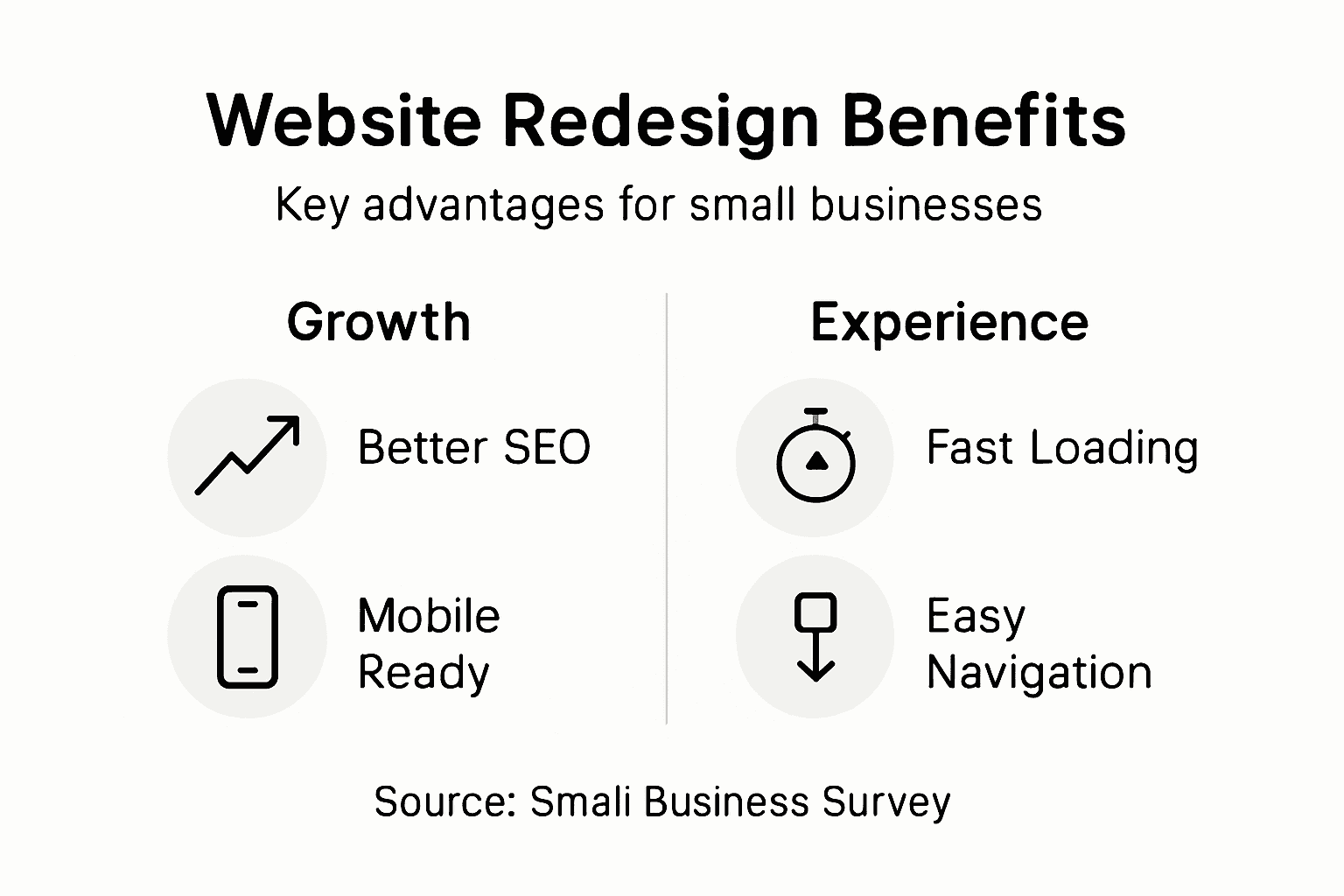
Careful implementation of responsive design principles ensures that websites not only look professional but also perform efficiently across various devices, creating a seamless user experience that supports business growth.
Pro tip: Regularly test your website’s mobile performance using free tools like Google PageSpeed Insights to identify and address potential optimisation opportunities.
Financial impact and long-term growth
Website redesign represents a strategic investment with significant potential for financial transformation and sustained business development. Workplace redesign research highlights how carefully planned digital investments can generate substantial long-term economic benefits for small businesses.
Financial advantages of strategic website redesign include:
-
Direct Revenue Generation
- Increased conversion rates
- Enhanced user engagement
- Improved customer acquisition
- Streamlined sales funnels
-
Cost Reduction Strategies
- Lower customer support expenses
- Reduced marketing acquisition costs
- Efficient information delivery
- Minimised website maintenance overhead
-
Competitive Market Positioning
- Differentiation from competitors
- Professional brand perception
- Enhanced digital credibility
- Attraction of higher-quality clients
-
Long-Term Business Growth
- Scalable digital infrastructure
- Adaptable website architecture
- Improved market responsiveness
- Foundation for future digital expansion
Small businesses can leverage website redesigns as strategic tools for economic development, transforming digital platforms from mere online brochures into dynamic revenue-generating assets. The initial investment creates compounding returns through improved user experience, search engine visibility, and brand positioning.
Careful analysis and strategic implementation are crucial, ensuring that redesign efforts align precisely with business objectives and deliver measurable financial improvements.
Pro tip: Track key performance indicators such as conversion rates, bounce rates, and average session duration before and after your website redesign to quantify the financial impact.
Risks, mistakes, and choosing alternatives
Website redesigns are complex undertakings fraught with potential pitfalls that can derail business objectives and waste valuable resources. Common redesign failures reveal critical mistakes small businesses must proactively avoid to ensure successful digital transformations.
Common risks and potential mistakes include:
-
Strategic Planning Errors
- Insufficient user research
- Unclear project objectives
- Unrealistic budget expectations
- Lack of comprehensive scope definition
-
Technical Implementation Risks
- Incompatible technology migrations
- Unexpected functionality breakdowns
- Performance degradation
- Security vulnerability introduction
-
User Experience Disruptions
- Dramatic navigation changes
- Loss of familiar site structures
- Alienating existing user base
- Reduced conversion rates
-
Financial Miscalculations
- Budget overruns
- Hidden implementation costs
- Extended development timelines
- Opportunity cost of prolonged redesign
Small businesses have several alternatives to comprehensive redesigns that can mitigate risks while still improving digital presence. Incremental updates, modular improvements, and strategic page-by-page refinements offer more controlled approaches to website evolution.
Careful planning, continuous user feedback, and phased implementation are crucial strategies for minimising potential negative outcomes. Businesses should view website redesign as an ongoing process of refinement rather than a single, high-stakes event.
Pro tip: Conduct user testing and gather stakeholder feedback throughout the redesign process to identify potential issues before full implementation.
Unlock the Full Potential of Your Website with WebFuZsion
If you feel overwhelmed by the complexities of website redesign and uncertain about how to align your digital presence with business goals WebFuZsion understands these challenges. The article highlights crucial pain points such as avoiding common redesign mistakes improving user experience and achieving real SEO and financial benefits. Our team specialises in tailored website redesign solutions that balance aesthetic appeal with functional excellence including responsiveness fast loading times and intuitive navigation all essential elements identified in your digital journey.
Don’t let strategic planning errors or poor implementation hold your business back. Take control with custom website redesign services designed specifically for small to medium-sized businesses seeking long-term growth. Explore how our expertise in SEO integration and performance optimisation can help transform your site into a powerful tool for conversion and customer engagement. Start with a comprehensive website audit and see measurable improvements by partnering with professionals committed to your success.
Ready to elevate your online presence and experience the benefits of a thoughtfully executed redesign Visit WebFuZsion today to discuss your requirements and get started on a website that truly works for you.
Recommended
Related Links
Frequently Asked Questions
What are the main benefits of a website redesign for small businesses?
A website redesign can improve user experience, enhance mobile optimisation, boost SEO performance, and ultimately lead to increased conversions and revenue for small businesses.